Apply for this course
Please select when you would like to start:
If you're a UK applicant wanting to study full-time starting in September, you must apply via UCAS unless otherwise specified. If you're an international applicant wanting to study full-time, you can choose to apply via UCAS or directly to the University.
If you're applying for part-time study, you should apply directly to the University. If you require a Student visa, please be aware that you will not be able to study as a part-time student at undergraduate level.
Why study this course?
This is a top-up version of our Fine Art BA (Hons) degree. A top-up degree is the final year (Level 6) of an undergraduate degree course and is for those who have a foundation degree, Higher National Diploma or equivalent qualification, or those wishing to study the final year of their degree in London.
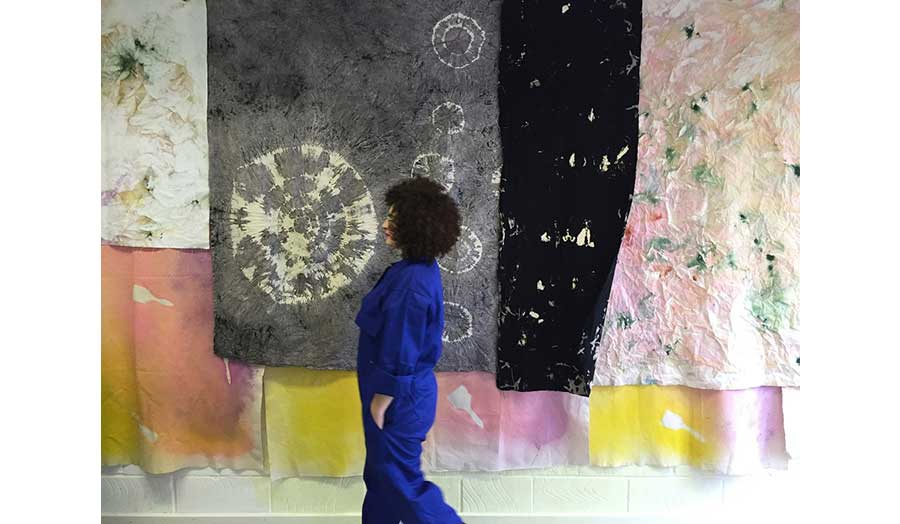
On this superb fine art degree you’ll be taught by internationally renowned artists in our state-of-the-art facilities, attend international events and gain all the skills and expertise you'll need to succeed as an artist.
Visit our Fine Art BA online degree show to see what our students have achieved over the past year and celebrate their successes with us!
Benefit from a range of internal and external activities and experts
There will be artists in residence, art awards, access to private viewings, regular field trips to the Venice Biennale and other European art events plus invaluable advice from artists who’ll guide you into your art career
Learn from industry professionals and exhibit your work
You’ll benefit from our expert artists-in-residence and have the opportunity to exhibit your work in major student exhibitions attended by art professionals
Gain access to our amazing facilities
We have spacious art studios, the latest 3D printing and laser-cutting facilities, exhibition spaces and even a roof garden, as well as state-of-the-art digital media, print, painting, photography, ceramics and sculpture workshops
Course details
In addition to the University's standard entry requirements, you should have one of the following:
- 240 credits from a Higher National Diploma (HND), Foundation Degree (FdA/ FdSc) or equivalent international qualification in a relevant subject
- 240 credits from years 1 and 2 of an undergraduate degree (BA/BSc) in a relevant subject at a different institution
- a portfolio interview
Suitable applicants living in the UK will be invited to a portfolio interview. Applicants living outside the UK will be required to submit a portfolio of work via email.
Portfolios and interviews
Your portfolio should be selective but have enough work to show the range of your interests and talents. We're interested in seeing how you develop a project from beginning to end, not only finished work.
Physical portfolio
If you are coming in person to your interview we strongly suggest bringing a physical portfolio of work.
Things to bring:
- Sketchbooks – we love to see your sketchbooks with ideas and notes, even if they are messy
- Examples of the development of a project from start to finish and the final outcome
- Some work that you are really proud of and want to talk about
- Some work that shows you experimenting with different processes
Digital portfolio
If you are submitting an online application, please follow these guidelines.
Things to include:
- Scans or photographs demonstrating items from the list above
- Storyboarding for motion-based work
- Scans of sketchbook pages showing development
- Be sure to check the resolution and overall quality of your image to ensure submissions are not pixelated
Accreditation of Prior Learning
Any university-level qualifications or relevant experience you gain prior to starting university could count towards your course at London Met. Find out more about applying for Accreditation of Prior Learning (APL).
English language requirements
To study a degree at London Met, you must be able to demonstrate proficiency in the English language. If you require a Student visa (previously Tier 4) you may need to provide the results of a Secure English Language Test (SELT) such as Academic IELTS. This course requires you to meet our standard requirements.
If you need (or wish) to improve your English before starting your degree, the University offers a Pre-sessional Academic English course to help you build your confidence and reach the level of English you require.
Assessment is through practical and written coursework. Practical coursework is developed in workshops and studios, while some written project development coursework is developed online. Coursework is marked in percentages according to a standard band of passing grades by a group of art examiners using clear, published assessment criteria.
You will also be involved in formative assessment during the year. This includes tutorials in which you will be given valuable verbal and written feedback on your art project proposals, works in progress and draft submissions, helping you to build on your individual strengths.
There are no examinations.
Many organisations value a Fine Art graduate’s creativity very highly, and you’ll be joining the School’s proud list of students, which includes famous artists such as Tracey Emin, Sam Taylor-Wood, John Cecil Stephenson and Professor Gerard Hemsworth.
There are a wide range of job opportunities as artists, curators, art critics and art journalists, as previous graduates will testify. Others have gone on to become artists' assistants, art technicians, gallery administrators, art event organisers, marketers, auctioneers, print technicians, photographers, video producers and studio managers.
Alternative career paths include arts officers for local government, art teachers, art tutors and lecturers. Some graduates have even pursued rewarding roles as art therapists, working in hospitals, day care, rehabilitation, prisons and the probation service.
There’s also the chance that your work may one day be displayed alongside our past students. Organisations that host work by our graduates include the Tate Modern, Tate Britain, Venice Biennale, ICA, Henry Moore Foundation, Yorkshire Sculpture Park, The Department for Culture, Media and Sport, Museum of Modern Art, Guggenheim, Art Basel, Frieze, Parkett, Artforum, The English Arts Council and the Pompidou Centre.
We currently have three locations in Holloway, Aldgate and Shoreditch. As we evolve as a University, we'll be reviewing the use of these spaces to ensure all our students have access to the facilities and study areas they need to succeed. This means the campus where this course is taught may change over time.
The experience of our students will always be our top priority and we'll notify applicants and students of any changes to their teaching location at the earliest opportunity.
If you study your undergraduate degree with us, as a graduate of London Met, you'll be entitled to a 20% discount on a postgraduate course if you continue your studies with us.
* exclusions apply
Please note, in addition to the tuition fee there may be additional costs for things like equipment, materials, printing, textbooks, trips or professional body fees.
Additionally, there may be other activities that are not formally part of your course and not required to complete your course, but which you may find helpful (for example, optional field trips). The costs of these are additional to your tuition fee and the fees set out above and will be notified when the activity is being arranged.
Treat yourself to snaps of our latest students' work and news from the course by following us on Instagram @metartlondon.
You can follow our School of Art, Architecture and Design on Twitter, Facebook and Instagram to stay up to date with everything that's happening in our creative community.
How to apply
If you're a UK applicant wanting to study full-time starting in September, you must apply via UCAS unless otherwise specified. If you're an international applicant wanting to study full-time, you can choose to apply via UCAS or directly to the University.
If you're applying for part-time study, you should apply directly to the University. If you require a Student visa, please be aware that you will not be able to study as a part-time student at undergraduate level.
When to apply
The University and Colleges Admissions Service (UCAS) accepts applications for full-time courses starting in September from one year before the start of the course. Our UCAS institution code is L68.
If you will be applying direct to the University you are advised to apply as early as possible as we will only be able to consider your application if there are places available on the course.
To find out when teaching for this degree will begin, as well as welcome week and any induction activities, view our academic term dates.
.jpg)


,-Janette-Parris.jpg)