Apply for this course
Please select when you would like to start:
If you're a UK applicant wanting to study full-time starting in September, you must apply via UCAS unless otherwise specified. If you're an international applicant wanting to study full-time, you can choose to apply via UCAS or directly to the University.
If you're applying for part-time study, you should apply directly to the University. If you require a Student visa, please be aware that you will not be able to study as a part-time student at undergraduate level.
Why study this course?
This is a top-up version of our Architecture BA (Hons) degree. A top-up degree is the final year (Level 6) of an undergraduate degree course and is for those who have a foundation degree, Higher National Diploma or equivalent qualification, or those wishing to study the final year of their degree in London.
Advanced Level 6 entry to this course offers you a multifaceted design-based education that, on successful completion (120 credits on either a full-time or part-time basis), provides exemption from Royal British Institute of British Architects (RIBA) 1 – the first stage of a professional qualification in architecture. Typically, graduates go on to RIBA Part 2 and RIBA Part 3 at London Metropolitan University.
You must complete a total of 120 credits, studying either on a full-time of part-time basis, to be eligible for RIBA/ARB Part 1.
Fourth in London for student satisfaction
Our architecture courses are ranked fourth in London for student satisfaction in the Complete University Guide 2025
Validated by professional UK architectural bodies
The course is validated by the Royal Institute of British Architects (RIBA) and prescribed by the Architects’ Registration Board (ARB)
Taught by leading practitioners
Our lecturers will bring a wealth of technical expertise to your learning experience and provide insight into industry best practices
Course details
In addition to the University's standard entry requirements, you should have one of the following:
- 240 credits from a Higher National Diploma (HND), Foundation Degree (FdA/ FdSc) or equivalent international qualification in a relevant subject
- 240 credits from Years 1 and 2 of an undergraduate degree (BA/BSc) in a relevant subject at a different institution
- a portfolio interview
Suitable applicants living in the UK will be invited to a portfolio interview. Applicants living outside the UK will be required to submit a portfolio of work via email. To find out what to include in your portfolio, view our portfolio guidance.
Portfolios and interviews
Your portfolio should be selective but have enough work to show the range of your interests and talents. We're interested in seeing how you develop a project from beginning to end, not only finished work.
Physical portfolio
If you are coming in person to your interview we strongly suggest bringing a physical portfolio of work.
Things to bring:
- Sketchbooks – we love to see your sketchbooks with ideas and notes, even if they are messy
- Examples of the development of a project from start to finish and the final outcome
- Some work that you are really proud of and want to talk about
- Some work that shows you experimenting with different processes
Digital portfolio
If you are submitting an online application, please follow these guidelines.
Things to include:
- Scans or photographs demonstrating items from the list above
- Storyboarding for motion-based work
- Scans of sketchbook pages showing development
- Be sure to check the resolution and overall quality of your image to ensure submissions are not pixelated
Accreditation of Prior Learning
Any university-level qualifications or relevant experience you gain prior to starting university could count towards your course at London Met. Find out more about applying for Accreditation of Prior Learning (APL).
English language requirements
To study a degree at London Met, you must be able to demonstrate proficiency in the English language. If you require a Student visa (previously Tier 4) you may need to provide the results of a Secure English Language Test (SELT) such as Academic IELTS. This course requires you to meet our standard requirements.
If you need (or wish) to improve your English before starting your degree, the University offers a Pre-sessional Academic English course to help you build your confidence and reach the level of English you require.
The Architects' Registration Board (ARB) and the Royal Institute of British Architects (RIBA) set out general criteria for assessment within the Prescription of Qualifications.
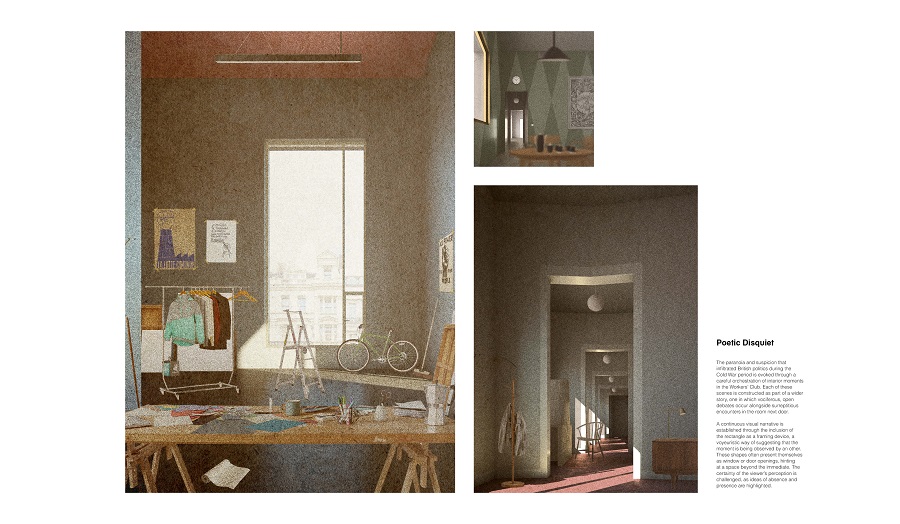
Project work makes up 50% of your final mark and you'll be assessed primarily on your achievements, demonstration of competence and the quality of the work in your portfolio.
Following successful completion of the course, most graduates go on to complete their Royal Institute of British Architects (RIBA) Part 2 and 3 and gain a professional qualification in architecture. Previous alumni have worked for companies such as Caruso St John, David Chipperfield Architects, Macreanor Lavington, Tony Fretton Architects and SANAA in Tokyo.
Graduating with this degree provides you with the core knowledge and skills needed to work in fields such as interior design, urban design and planning. You'll leave with a high-quality portfolio of work, an understanding of relevant cultural and social issues and the research, design, making and presentation skills valued in many design-related professions.
Our architecture graduates have gone on to exciting careers as architects, design consultants, architectural assistants and designers at impressive practices including Eric Parry Architects, Stephen Taylor Architects, Adamson Associates Architects, and Conrad and Partners.
We currently have three locations in Holloway, Aldgate and Shoreditch. As we evolve as a University, we'll be reviewing the use of these spaces to ensure all our students have access to the facilities and study areas they need to succeed. This means the campus where this course is taught may change over time.
The experience of our students will always be our top priority and we'll notify applicants and students of any changes to their teaching location at the earliest opportunity.
If you study your undergraduate degree with us, as a graduate of London Met, you'll be entitled to a 20% discount on a postgraduate course if you continue your studies with us.
* exclusions apply
Please note, in addition to the tuition fee there may be additional costs for things like equipment, materials, printing, textbooks, trips or professional body fees.
Additionally, there may be other activities that are not formally part of your course and not required to complete your course, but which you may find helpful (for example, optional field trips). The costs of these are additional to your tuition fee and the fees set out above and will be notified when the activity is being arranged.
Follow our School of Art, Architecture and Design on Twitter, Facebook and Instagram to stay up to date with everything that's happening in our creative community.
For an insight into what's going on with the Metropolitan Architecture Student Society you can also follow MASS on Instagram.
Discover Uni – key statistics about this course
Discover Uni is an official source of information about university and college courses across the UK. The widget below draws data from the corresponding course on the Discover Uni website, which is compiled from national surveys and data collected from universities and colleges. If a course is taught both full-time and part-time, information for each mode of study will be displayed here.
How to apply
If you're a UK applicant wanting to study full-time starting in September, you must apply via UCAS unless otherwise specified. If you're an international applicant wanting to study full-time, you can choose to apply via UCAS or directly to the University.
If you're applying for part-time study, you should apply directly to the University. If you require a Student visa, please be aware that you will not be able to study as a part-time student at undergraduate level.
When to apply
The University and Colleges Admissions Service (UCAS) accepts applications for full-time courses starting in September from one year before the start of the course. Our UCAS institution code is L68.
If you will be applying direct to the University you are advised to apply as early as possible as we will only be able to consider your application if there are places available on the course.
To find out when teaching for this degree will begin, as well as welcome week and any induction activities, view our academic term dates.





.jpg)


.jpg)